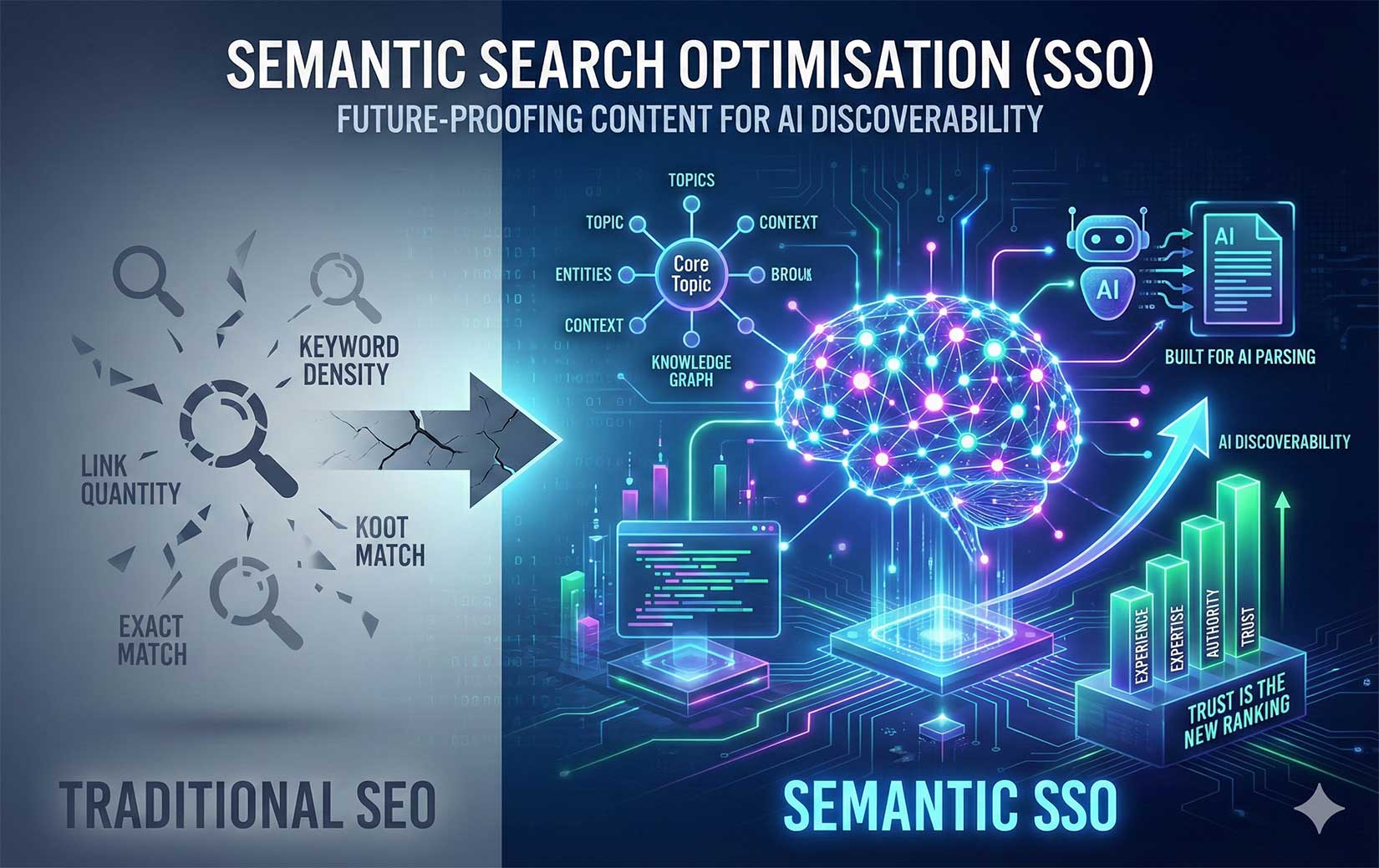
Semantic Search Optimisation (SSO): Future-Proofing Content for AI Discoverability
In the rapidly evolving digital landscape, where AI systems and large language models (LLMs) such as ChatGPT, Google Gemini, and Claude are becoming primary gateways to information, traditional search engine optimisation (SEO) practices are no longer enough. Success in visibility now depends on how well content can be understood by AI — not just indexed by algorithms. This is where Semantic Search Optimisation (SSO) enters the stage.
SSO represents the next generation of discoverability — it’s about structuring and expressing content so that AI systems can fully grasp context, meaning, and relationships between concepts. In this comprehensive guide, we’ll explore the rise of semantic optimisation, why it matters in the age of language models, and how to strategically apply its principles to future-proof your content.
Introduction: The Shift from Traditional SEO to Semantic Search
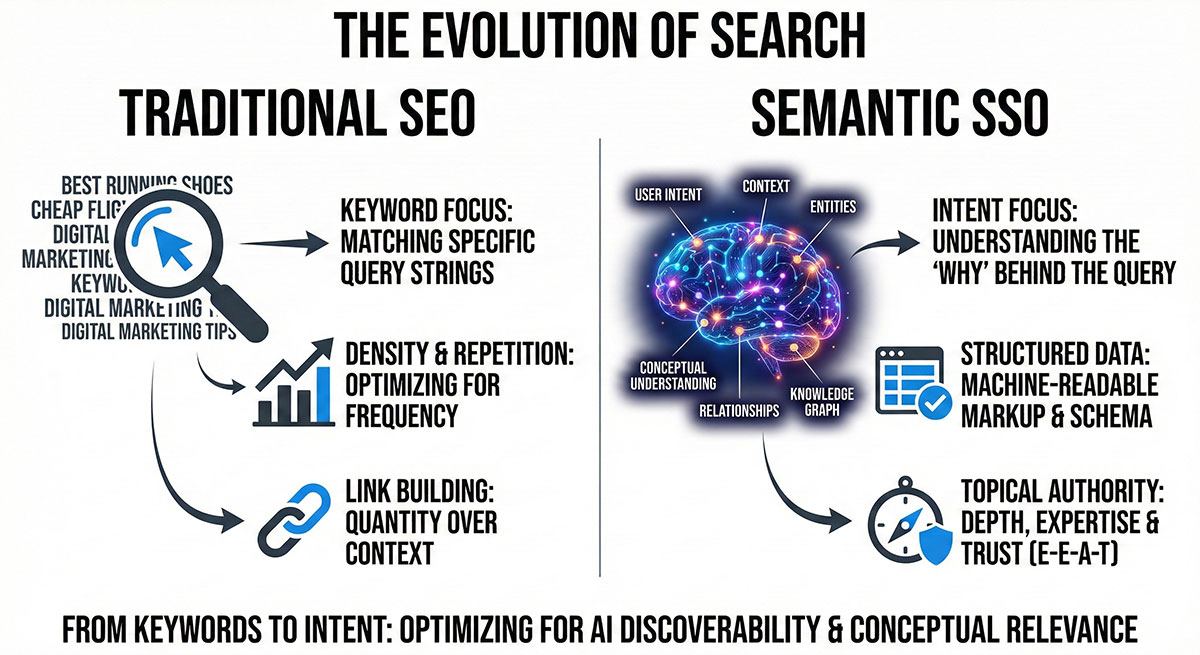
For over two decades, traditional SEO has revolved around keywords, backlinks, and metadata. The goal was clear: match user queries and achieve higher rankings on search engine results pages. However, AI-powered search tools don’t rely solely on keyword matching — they interpret.
Unlike traditional crawling and indexing systems, modern search and AI discovery tools use semantic understanding to identify the intent behind queries. AI models process meaning, context, and interrelated information, not just strings of text.
This transformation means that simply optimising for “keywords” or “keyword density” isn’t enough. The future belongs to semantic search — where contextual clarity, linguistic precision, and structured meaning define discoverability.
According to Saloni Kohli, content that provides clearly defined entities, relationships, and citations is far more likely to be surfaced by AI-driven discovery systems, marking the end of purely keyword-based rankings.
What is Semantic Search Optimisation (SSO)?
Semantic Search Optimisation (SSO) is a content strategy aimed at enhancing discoverability and comprehension for AI systems and language models. Rather than merely focusing on SEO metrics, SSO centres around how information is intellectually processed by models like GPT or Gemini.
The essence of SSO lies in aligning your content with the interpretative mechanisms of AI. When done effectively, this allows AI systems not only to recognise what your content says but also to understand what it means.
Key characteristics include:
– Contextual clarity: Defining topics in relation to one another via semantic links.
– Structural integrity: Using schema, headings, and consistent formatting to guide AI comprehension.
– Data and evidence: Embedding numeric and sourced information that reinforces authority.
– Conversational and accessible tone: Aligning language patterns with AI’s pre-training corpora.
In essence, SSO enables your content to communicate effectively with machines that think like humans. It transforms content from text into knowledge assets recognisable by both search engines and generative AI interfaces.
Why SSO Matters in the Age of LLMs and AI Agents
Search behaviours are fundamentally changing. Increasingly, users interact with AI interfaces instead of typing queries into search bars. Prompts like “summarise the best marketing strategies for 2024” rely on LLMs’ ability to retrieve semantically relevant content, not just keyword-matched text.
However, these language models depend heavily on context comprehension. AI agents prioritize content that is rich in context, citations, and factual precision.
Businesses that adopt SSO benefit in three key ways:
- AI Visibility: Optimised content is more likely to be retrieved and summarised correctly by LLMs.
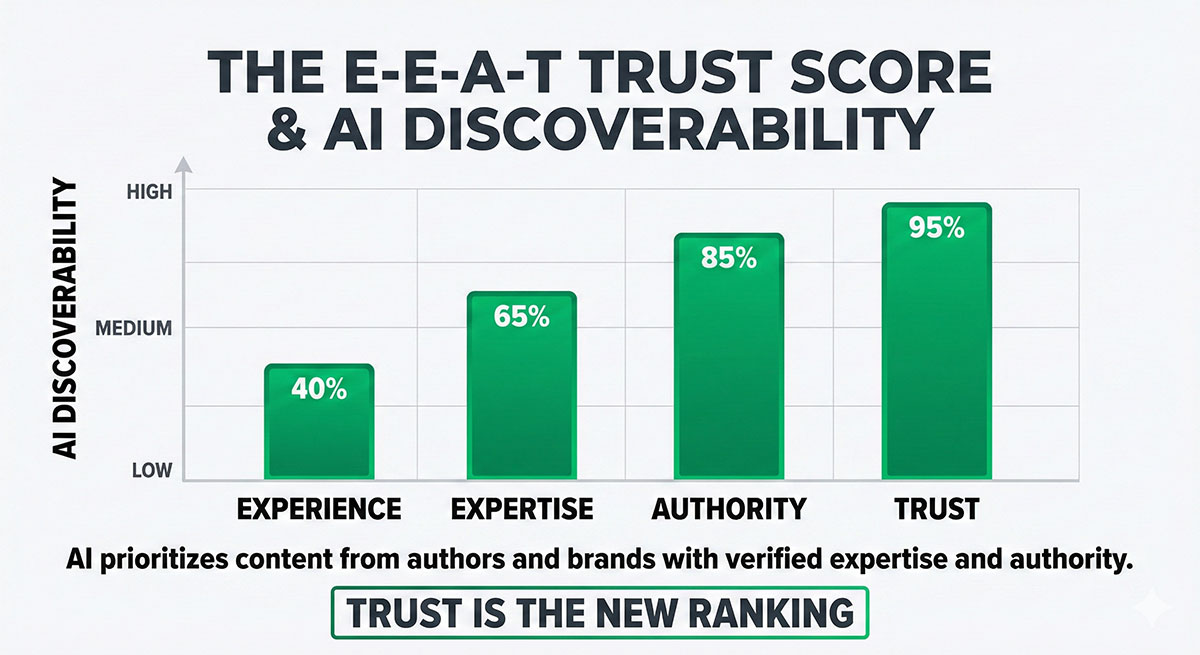
- Trust and Authority: Sources backed by verifiable, cited data appear more reliable to generative systems.
- Longevity in Search Discoverability: As AI-driven interfaces replace traditional search, SSO guarantees enduring relevance.
In a future where AI intermediaries choose which sources users see, training your content to be legible to those systems may be the single most strategic move in digital marketing.
Core Principles of Semantic Structuring for AI Readability
Content optimised for human readers isn’t always easily interpretable by machines. Semantic structuring ensures that meaning, hierarchy, and relationships are unambiguous. Here are the core principles to follow:
1. Authority Through Citations
Incorporate 5–10 credible citations per article to anchor statements in verifiable data. AI models are more likely to surface content that demonstrates evidence-based authority.
2. Data-Driven Storytelling
Including numerical data and measurable facts enhances visibility in AI aggregations, as models favour quantifiable context over abstract claims.
3. Conversational Formatting
Using FAQ sections and Q&A formats mimics the way AI models process human dialogue.
4. Clarity and Simplicity
According to sabrepc, concise language and short sentences aid LLM parsing by reducing ambiguity.
5. Logical Headings and Lists
Hierarchical structure — H2s for major topics, H3s for sub-points — allows models to identify and summarise relationships effectively.
When implemented collectively, these principles turn a text document into a machine-navigable semantic map.
Techniques for Semantic Content Optimisation
Optimising for AI discoverability requires specific on-page strategies:
1. Entity Definition and Contextual Linking
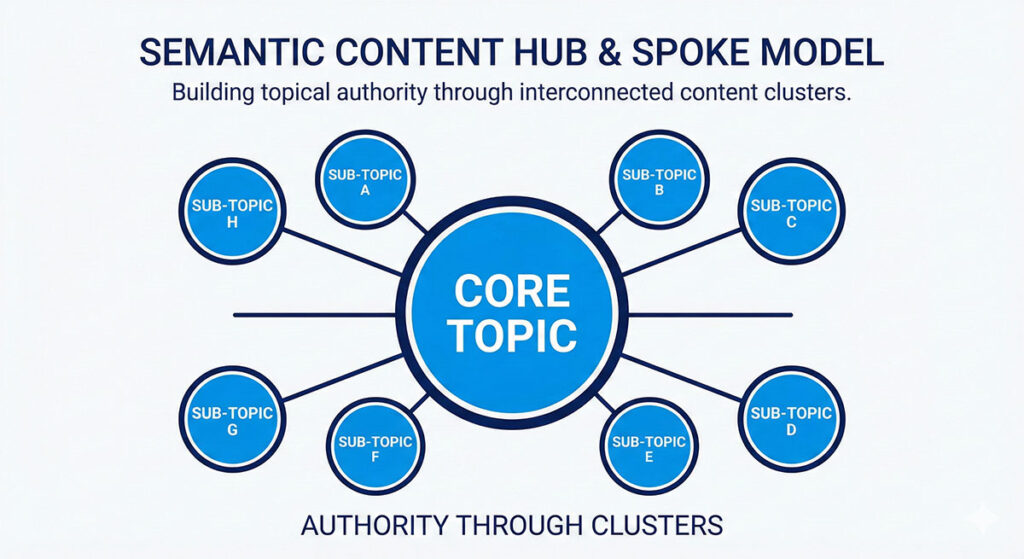
Explicitly define key entities and connect related terms using internal links. For instance, linking “semantic markup” to “structured data” helps AI establish conceptual relationships.
2. Comprehensive Topic Coverage
Cover topics holistically, addressing definitions, use cases, challenges, and examples. Depth creates a semantic footprint recognised by language models.
3. Integrate Structured Data and JSON-LD
Using schema.org markup or JSON-LD scripts gives models explicit metadata — who the author is, what the topic covers, and how it fits within broader knowledge graphs.
4. Optimise Metadata for Summaries
Use semantic meta descriptions that succinctly reflect content meaning. AI models often quote or paraphrase these sections during summarisation.
5. Ensure Crawl Accessibility
Avoid blocking AI bots or LLM scrapers via robots.txt settings and maintain clean HTML code.
Leveraging Schema, Ontologies, and Semantic Layers
Advanced SSO goes beyond basic structure — it taps into data modelling frameworks like ontologies and knowledge graphs.
– Schema Markup: Embeds standardised metadata that describes what your content is about.
– Ontologies: Create hierarchical relationships among concepts, helping LLMs connect your content with broader subject networks.
– Semantic Layers: Enable cross-page and cross-platform understanding, where AI systems interpret your brand or content library as a cohesive information ecosystem.
For example, an ecommerce brand using Product Schema with attributes like “Material,” “Price,” and “Category” enables AI tools to retrieve complete product insights, not just snippets.
Balancing Human Readability and AI Parsing Needs
The art of SSO lies in dual optimisation: content must satisfy human engagement *and* algorithmic clarity.
To achieve this:
– Write naturally — avoid over-engineering for machines.
– Maintain emotional resonance and storytelling for user connection.
– Structure information in layers: simple at the surface, structured underneath.
Think of SSO as writing for both the reader and the reader’s assistant. AI parsing shouldn’t detract from narrative flow; instead, it enhances accessibility.
Case Studies: Brands Implementing SSO Successfully
1. B2B SaaS Case — Clearbit
By introducing structured data to define service categories and customer personas, Clearbit boosted its appearance in AI content summaries across major LLM platforms.
2. News Publisher Example — The Conversation
Integrating ontology-driven tagging improved contextual relevance in AI-generated summaries, leading to higher inclusion rates in Gemini and ChatGPT responses.
3. Ecommerce Example — Wayfair
Using granular schema markup on product pages enabled Wayfair to dominate AI-powered product recommendations and conversational commerce results.
These early adopters reveal a pattern: those who invest in clear semantics, structured meaning, and factual authority gain first-mover advantage in AI-driven visibility.
Challenges and Future Directions in SSO
While promising, SSO faces technical and strategic hurdles:
– Evolving Standards: AI systems continually update understanding frameworks, demanding adaptive optimisation.
– Data Privacy and Transparency: As AI scrapes more semantic metadata, ensuring ethical use and compliance becomes critical.
– Over-structuring Risks: Excessive markup or forced relationships can confuse rather than clarify meaning.
The future of SSO will likely converge with Generative Engine Optimisation (GEO) — a discipline merging semantic optimisation with model-specific training influence. Businesses that embed adaptability into their strategies today will be best positioned for AI-native discovery tomorrow.
Conclusion: Preparing for an AI-First Search Future
Semantic Search Optimisation is not a passing trend — it’s a fundamental shift in how machines and humans co-interpret information. As generative AI continues to mediate how knowledge is discovered, cited, and shared, the visibility battleground is no longer limited to traditional search engines.
Implementing SSO today means ensuring that your content is not just searchable, but understandable. It means your ideas won’t get lost in translation between human language and machine logic.
Future-proof your content by making it semantically rich, structurally clear, and contextually meaningful — because in the age of AI, clarity is the new currency of discoverability.